4 Month Old Feeding Schedule: 7 Feeds a Day Guide (2026)
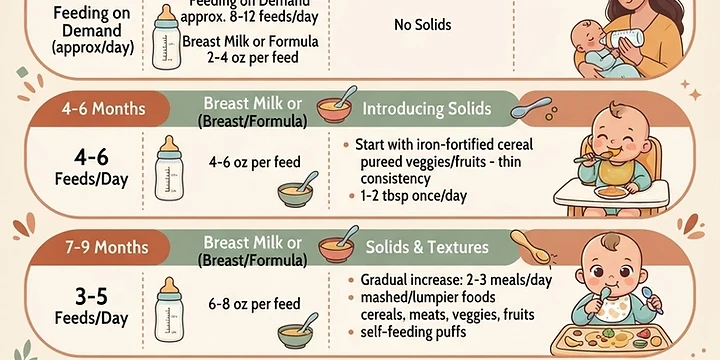
Free printable: the 6-month baby feeding chart
Grab the same chart we reference in this guide as a printable PDF — pin it to the fridge, no more guessing at portions.


In this article
- 1.Important: Solids Start at 6 Months, Not 4 — AAP & WHO Guidance
- 2.Understanding the 4 Month Old Feeding Schedule
- 3.Sample Daily Feeding Plan for a 4 Month Old
- 4.Feeding Plan vs Strict Schedule: What's the Difference?
- 5.Signs of Hunger and Fullness at 4 Months
- 6.Breastfed vs Formula-Fed: How the 4 Month Old Feeding Schedule Differs
- 7.Common Questions Parents Have at 4 Months
- 8.Preparing for Solids After the 4 Month Old Feeding Schedule
- 9.Frequently Asked Questions
- 10.Conclusion
Important: Solids Start at 6 Months, Not 4 — AAP & WHO Guidance
Before diving into the 4 month old feeding schedule, here is the single most important thing to know: the American Academy of Pediatrics (AAP) and the World Health Organization (WHO) both recommend introducing solid foods at around 6 months of age, not at 4 months. This page is entirely about milk and formula feeding schedules for 4-month-olds — every ounce of nutrition at this age should come from breastmilk or formula. The AAP states that exclusive breastfeeding (or formula feeding) for the first 6 months provides optimal nutrition and immune protection, and that starting solids too early can increase the risk of allergies, choking, and digestive issues. The WHO echoes this guidance, recommending exclusive breastfeeding for 6 months followed by nutritionally adequate and safe complementary foods. The Centers for Disease Control and Prevention (CDC) also advises waiting until around 6 months and watching for developmental readiness signs — sitting with minimal support, holding the head steady, losing the tongue-thrust reflex, and showing genuine interest in food. If you are here because your baby is reaching for your plate at 4 months, that curiosity is normal but does not mean they are ready for solids. For when the time comes, see our 6 month old feeding schedule and our baby food recipes for 6 months.


Understanding the 4 Month Old Feeding Schedule
The 4 month old feeding schedule is a transitional period — your baby is growing rapidly but not yet ready for solid foods. At 4 months, the 4 month old feeding schedule focuses entirely on breastmilk or formula, with no solids introduced yet. The 4 month old feeding schedule typically calls for 4 to 6 ounces per feeding, 5 to 6 times per day, totaling 24 to 32 ounces. However, every baby is different, and the 4 month old feeding schedule should be guided by hunger cues rather than rigid numbers. At 4 months, your baby may begin to show interest in food — watching you eat, reaching for your plate — but this does not mean they are ready for solids. The AAP recommends waiting until 6 months to start solids, so the 4 month old feeding schedule remains milk-only. The 4 month old feeding schedule may include a sleep regression around this time, as your baby's sleep cycles mature — this can temporarily disrupt feeding patterns. Stick with the 4 month old feeding schedule and feed on demand; the regression is temporary. Growth spurts in the 4 month old feeding schedule may cause increased hunger for 2 to 3 days — follow your baby's cues and feed more frequently during these periods. The CDC notes that a feeding plan for 4 month old babies should prioritize responsive feeding — watching for and responding to hunger and fullness cues — over clock-based scheduling.
Ready to put this into practice?
Get our expert-crafted feeding guides and meal plans.


Sample Daily Feeding Plan for a 4 Month Old
Here is a sample daily routine for the 4 month old feeding schedule. 7:00 AM — Wake up and milk feed (5 to 6 ounces). 10:00 AM — Milk feed (5 to 6 ounces). 1:00 PM — Milk feed (5 to 6 ounces). 4:00 PM — Milk feed (5 to 6 ounces). 7:00 PM — Milk feed (5 to 6 ounces) before bedtime. 10:00 PM — Dream feed (optional, 4 to 5 ounces). This 4 month old feeding schedule provides 5 to 6 feedings totaling 28 to 32 ounces. Some babies in the 4 month old feeding schedule may still feed once overnight — this is normal. The 4 month old feeding schedule should be flexible: if your baby seems hungry earlier, feed them; if they are not interested, do not force. The intervals in the 4 month old feeding schedule are typically 3 to 4 hours during the day. By following a consistent 4 month old feeding schedule, you help regulate your baby's hunger patterns and prepare for the transition to solids at 6 months. The 4 month old feeding schedule is also a good time to introduce a sippy cup with water during playtime — not for nutrition, but for practice. Breastfed babies on this feeding plan may feed 6 to 8 times per day in slightly shorter sessions, since breastmilk digests faster than formula.
Feeding Plan vs Strict Schedule: What's the Difference?
A feeding plan for 4 month old babies is not the same as a strict schedule, and understanding the difference matters. A strict schedule means feeding at fixed times regardless of whether your baby is hungry — for example, insisting on a bottle at exactly 10:00 AM even if your baby is asleep or uninterested. A feeding plan, by contrast, is a flexible rhythm: it gives you a target number of feeds per day and rough intervals, but you adjust based on your baby's hunger cues. The AAP and CDC both recommend responsive feeding — watching for and responding to your baby's signals — rather than rigid, clock-based scheduling. A feeding plan for 4 month old babies says 'aim for 5 to 6 feeds every 3 to 4 hours, totaling 24 to 32 ounces,' but it lets you feed earlier if your baby is hungry from a growth spurt or later if they are still satisfied. Think of the 4 month old feeding schedule as a roadmap, not a train timetable. The goal is adequate total daily intake, not hitting exact times. This flexibility is especially important during the 4-month sleep regression and growth spurts, when hunger patterns shift temporarily. A responsive feeding plan builds trust and helps your baby develop a healthy relationship with food from the start.
Signs of Hunger and Fullness at 4 Months
Reading your baby's cues is the most reliable way to manage the 4 month old feeding schedule. The CDC emphasizes responsive feeding — responding to hunger and fullness cues rather than pushing a fixed volume. Hunger signs at 4 months include rooting (turning the head and opening the mouth toward your chest or hand), sucking on fists or fingers, lip smacking or sucking sounds, fussing or whimpering that escalates if not fed, and reaching toward a bottle or breast. Early hunger cues are subtle — catching them before your baby cries makes feeding easier for both of you. Crying is a late hunger sign and can make feeding more stressful. Fullness signs are equally important to recognize. At 4 months, fullness cues include turning the head away from the bottle or breast, closing the mouth or clamping lips shut, pushing the bottle or breast away with hands, slowing down or stopping sucking, becoming distracted and looking around instead of feeding, and falling asleep during a feed. When you see these signs, end the feed — even if the bottle is not empty. Forcing a baby to finish a bottle when they are full can override their natural fullness cues, a pattern the CDC links to overfeeding later in infancy. Trust your baby's signals over the ounce markings on the bottle.
Breastfed vs Formula-Fed: How the 4 Month Old Feeding Schedule Differs
The 4 month old feeding schedule looks slightly different depending on how you feed your baby. Breastfed babies at 4 months often feed more frequently — 6 to 8 times a day — because breastmilk digests faster than formula, while formula-fed babies typically settle into 5 to 6 feeds of 5 to 7 ounces each. Combination feeding falls somewhere in between, and the 4 month old feeding schedule for these babies usually shifts week to week as supply and appetite change. If you're wondering exactly how much should a 4 month old eat in ounces per day by feeding method, we break down the full range with real examples. Whichever method you use, the 4 month old feeding schedule should always be led by hunger cues, not the clock — a baby who finishes a bottle eagerly and still roots for more may need a slightly larger volume, while a baby who pulls away after 4 ounces is telling you they're satisfied. Some parents also start wondering about food for infants 4 months around this stage — while the AAP and WHO recommend waiting until 6 months, it's worth understanding the readiness signs in advance so you're not caught off guard when your baby starts reaching for your plate.
Common Questions Parents Have at 4 Months
The 4 month old feeding schedule comes with a cluster of common questions. Is my baby eating enough? The answer is in the diapers — the CDC says 6 or more wet diapers per day and steady weight gain (about 5 to 7 ounces per week at this age) indicate adequate intake. Is night feeding still normal? Yes — many 4 month olds still feed once overnight, and the 4-month sleep regression can temporarily increase night waking. Feed on demand; it resolves in 2 to 3 weeks. Why is my baby suddenly eating more? Growth spurts commonly hit around 4 months, increasing hunger for 2 to 3 days — follow the cues and feed more frequently. Why is my baby distracted during feeds? At 4 months, babies become more aware of their surroundings and may pull off to look around. Feed in a quiet, dimly lit room to help them focus. Should I introduce water? Small sips from a sippy cup during playtime are fine for practice, but water should not replace any milk in the 4 month old feeding schedule. When should I worry? Call your pediatrician if your baby consistently takes less than 20 ounces per day, has fewer than 6 wet diapers, is not gaining weight, or seems lethargic. For the exact ounce-by-ounce breakdown, see our guide on how much should a 4 month old eat.
Preparing for Solids After the 4 Month Old Feeding Schedule
While the 4 month old feeding schedule is milk-only, this is a good time to prepare for the solids transition at 6 months. Watch for readiness signs that will appear in the coming months: sitting with minimal support, holding head steady, showing interest in food, and losing the tongue-thrust reflex. The AAP and CDC note that these signs typically appear around 6 months, which is why both organizations recommend starting solids then. The 4 month old feeding schedule is also when you should discuss allergen introduction timing with your pediatrician — current AAP guidance supports early introduction of allergenic foods at 4 to 6 months for high-risk babies to reduce allergy risk, but this should always be done with pediatrician guidance. Do not introduce solids during the 4 month old feeding schedule unless specifically advised by your pediatrician for medical reasons (such as severe reflux). Track your baby's growth on the percentile chart during the 4 month old feeding schedule — consistent growth along a percentile line indicates adequate intake. For when the time comes, our 6 month old feeding schedule, our feeding schedule for a 6 month old by feeding type, and baby food recipes for 6 months cover the full solids transition. For a complete month-by-month feeding guide, explore our Baby Feeding Schedule by Month guide.
Frequently Asked Questions
How many ounces should a 4 month old eat?
The 4 month old feeding schedule calls for 4 to 6 ounces per feeding, 5 to 6 times per day, totaling 24 to 32 ounces. Breastfed babies may take 6 to 8 shorter feeds. Always feed on demand and follow hunger cues — the CDC recommends responsive feeding over fixed volumes.
How often should a 4 month old eat?
Most 4 month olds feed every 3 to 4 hours during the day, totaling 5 to 6 feedings (or 6 to 8 for breastfed babies). Some still feed once overnight, which is normal. Adjust intervals based on hunger cues rather than the clock.
When do I start solids?
The AAP and WHO both recommend introducing solid foods at around 6 months of age, not at 4 months. Wait until your baby can sit with support, hold their head steady, and has lost the tongue-thrust reflex. See our 6 month old feeding schedule for the full transition guide.
Can I start solids at 4 months?
The AAP and WHO recommend waiting until 6 months. The 4 month old feeding schedule should be milk-only unless your pediatrician advises early solids for medical reasons like severe reflux or for allergy prevention in high-risk babies.
Why is my 4 month old feeding more at night?
The 4 month sleep regression often disrupts feeding and sleep patterns as your baby's sleep cycles mature. Stick with the 4 month old feeding schedule and feed on demand — the regression is temporary and typically resolves in 2 to 3 weeks.
Is the 4 month old feeding schedule different for breastfed and formula-fed babies?
Yes. Breastfed babies typically feed 6 to 8 times a day due to faster digestion, while formula-fed babies settle into 5 to 6 feeds of 5 to 7 ounces. Both totals land in the same 24 to 32 ounce daily range.
What are hunger signs at 4 months?
Hunger signs include rooting, sucking on fists or fingers, lip smacking, fussing, and reaching for a bottle or breast. Crying is a late hunger sign — try to catch early cues before your baby gets upset.
What are fullness signs at 4 months?
Fullness signs include turning the head away, closing the mouth, pushing the bottle or breast away, slowing or stopping sucking, becoming distracted, and falling asleep. The CDC advises ending the feed when you see these signs — do not force a baby to finish a bottle.
Conclusion
The 4 month old feeding schedule is a milk-focused period that prepares your baby for the solids transition at 6 months — the AAP and WHO are clear that solids should wait. By maintaining consistent milk feeds, following hunger and fullness cues, and treating your feeding plan as a flexible rhythm rather than a rigid schedule, you set the stage for smooth feeding progression. For the exact ounce-by-ounce breakdown, see how much should a 4 month old eat; for the full month-by-month milk and solid-food view in one place, see our baby feeding chart; and for what comes next, explore our 6 month old feeding schedule and Baby Feeding Schedule by Month guide.
Ready to put this into practice?
Get our expert-crafted feeding guides and meal plans.


Dr. Emily Carter, MD
MD, Pediatrician
Pediatrician focused on infant growth and feeding schedules, helping parents translate AAP and WHO guidance into practical day-to-day routines.
Explore our feeding guides