Baby Feeding Schedule by Month
A month-by-month baby feeding schedule from 4 to 12 months — milk amounts, solid food portions, and daily schedules for every stage of the first year.
Why a Month-by-Month Schedule Helps
Your baby's nutritional needs change dramatically between 4 and 12 months — milk volumes shift, solid foods are introduced and expanded, and meal frequency evolves. Without some structure, it's easy to feel lost: how much milk should a 6-month-old drink, when should solids start, how many meals should a 9-month-old eat? A month-by-month framework answers all of that. Research shows babies who follow a consistent feeding pattern have better sleep, more predictable hunger cues, and smoother transitions to solids, and tracking against age-appropriate guidelines helps you spot potential issues early. The first year breaks into distinct phases: months 4-5 (milk only, preparing for solids), month 6 (introducing solids alongside milk), months 7-8 (expanding food variety and texture), months 9-10 (three meals plus milk), and months 11-12 (transitioning to table food and whole milk). Each phase has its own milk volume targets, solid portions, and meal-frequency guidance.
Months 4 to 6
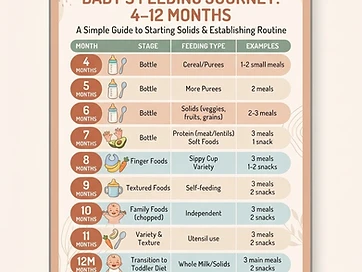
This first phase covers the period when milk is still the sole nutrition source for most babies. At 4 months, expect 4-6 ounces every 3-4 hours, totaling roughly 24-32 ounces across 4-6 feedings — most babies at this age feed about 5 times a day. At 5 months, it's similar: 6-8 ounces per feeding, 4-5 times a day, totaling 28-32 ounces. During these months you can start watching for readiness signs for solids — sitting with support, holding the head steady, showing interest in food, and losing the tongue-thrust reflex. At 6 months comes the biggest change: solids are introduced. The schedule then includes 6-8 ounces of milk, 4-5 times a day (24-32 oz total), plus one solid meal, starting with a single-ingredient puree — iron-fortified cereal, mashed avocado, or pureed sweet potato — offered once a day, ideally in the morning or at lunch so you can watch for reactions. Solids at this stage complement milk rather than replace it, and milk should always be offered first.
Months 7 to 9
This phase is when solid foods expand significantly. At 7 months, expect 6-8 ounces of milk, 4 times a day (24-32 oz total), plus two solid meals. You can widen the variety of purees and start offering soft finger foods if you're doing baby-led weaning, and iron-rich foods — meat puree, fortified cereal, egg yolk — should be part of the daily routine. At 8 months, solid meals increase to three a day alongside 24-30 ounces of milk (6-8 oz, 3-4 times a day), and textures should progress from smooth purees to mashed and lumpier options to support oral motor development. At 9 months, expect three meals plus one snack, with milk easing down to 20-24 ounces a day (4-6 oz, 3-4 times a day). Finger foods should be at every meal — soft-cooked vegetables, fruit spears, small pasta, finely shredded meat — and by 9 months your baby should be eating a wide range of foods across all groups. Throughout this window, iron-rich foods remain the priority, alongside varied textures and a gradual reduction in milk as solid intake climbs.
Months 10 to 12
The final phase brings your baby toward a toddler-like eating pattern. At 10 months, expect three meals plus two snacks, with 16-24 ounces of milk a day, and your baby eating most of the same foods as the rest of the family (appropriately cut and prepared). This is the stage to focus on self-feeding — offering finger foods at every meal and encouraging spoon use with help. At 11 months, the pattern holds steady: three meals, two snacks, 16-24 ounces of milk, with continued exposure to a wide variety of foods and textures. At 12 months comes a major milestone — the transition from breastmilk or formula to whole milk, if you're weaning — with three meals, two snacks, and 16-24 ounces of whole milk. Your 12-month-old should be eating table food at every meal, using utensils with help, and drinking from a cup. Throughout months 10-12, keep avoiding honey (until 12 months), choking hazards like whole grapes, nuts, and popcorn, added salt and sugar, and raw or undercooked foods. Treat this schedule as a roadmap rather than a rulebook — every baby is different, so follow hunger cues and check in with your pediatrician if you're concerned about intake or growth. For a complete guide with daily routines and portion charts, see our Baby Feeding Schedule by Month Guide below.
Newborn to 3 Years, Age by Age
| Age | Guide |
|---|---|
| Newborn (0-3 months) | Newborn Feeding Chart by Week |
| 1 month | 1 Month Old Feeding Schedule |
| 2 months | 2 Month Old Feeding Schedule |
| 3 months | 3 Month Old Feeding Schedule |
| 4 months | 4 Month Old Feeding Schedule |
| 5 months | 5 Month Old Meal Plan |
| 6 months | 6 Month Old Feeding Schedule |
| 7 months | 7 Month Old Feeding Schedule |
| 8 months | 8 Month Old Feeding Schedule |
| 9 months | 9 Month Old Meal Plan |
| 10 months | 10 Month Old Feeding Schedule |
| 11 months | 11 Month Old Feeding Schedule |
| 12 months | 12 Month Old Feeding Schedule |
| 12-18 months | 1 Year Old Meal Plan |
| 18-24 months | 18-24 Month Old Meal Plan |
| 1-3 years | Toddler Nutrition Guide |
Medically reviewed by Dr. Sarah Chen, MD · See our editorial policy
Featured Guides

 Pediatrician-createdBaby Feeding Schedule by Month
Baby Feeding Schedule by Month Guide
A month-by-month baby feeding schedule from 4 to 12 months — milk amounts, solid food portions, daily routines, and transition guides for every stage.
eBook (PDF)
Frequently Asked Questions
How much milk should my baby drink by month?
4-5 months: 24-32 oz across 4-5 feedings. 6 months: 24-32 oz plus 1 solid meal. 7-8 months: 24-30 oz plus 2-3 solid meals. 9-12 months: 16-24 oz plus 3 meals and snacks.
When should I start solids?
Solids typically start at 6 months, once your baby can sit with support, hold their head steady, and shows interest in food. Start with one meal a day and increase gradually.
How many meals should a 9-month-old eat?
By 9 months, expect three solid meals plus one snack, alongside 20 to 24 ounces of milk. Finger foods should be offered at every meal.