Feeding Schedule for a 6 Month Old: By Feeding Type (2026)


In this article
- 1.Why the Feeding Schedule for a 6 Month Old Depends on Feeding Type
- 2.Feeding Schedule for a 6 Month Old Who Is Breastfed
- 3.Feeding Schedule for a 6 Month Old Who Is Formula-Fed
- 4.Feeding Schedule for a 6 Month Old Who Is Combination-Fed
- 5.How Baby-Led Weaning Changes the Solids Timing
- 6.When the Schedule Gets Disrupted: Teething, Travel, and Growth Spurts
- 7.Frequently Asked Questions
- 8.Conclusion
Why the Feeding Schedule for a 6 Month Old Depends on Feeding Type
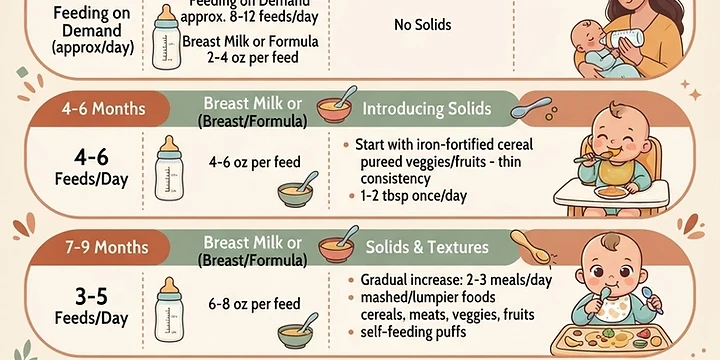
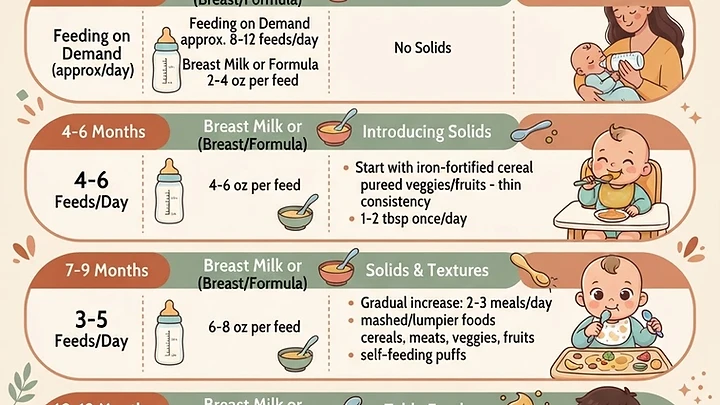
There is no single feeding schedule for a 6 month old — the right routine depends heavily on whether your baby is breastfed, formula-fed, or combination-fed. The American Academy of Pediatrics (AAP) and World Health Organization (WHO) both set the same overall targets regardless of feeding type: roughly 24 to 32 ounces of breastmilk or formula per day, plus one to two small solid meals once your baby shows readiness signs (sitting with support, steady head control, and loss of the tongue-thrust reflex). What changes between feeding types is not the total amount but the rhythm — how many feeds per day, how long each one takes, and how predictable the timing is. A feeding schedule for a 6 month old who nurses will usually have more, shorter sessions than one built around a bottle, because breastmilk digests faster than formula. Solids timing, on the other hand, stays consistent across every feeding type: offer milk first, then a small solid meal 30 to 60 minutes later so your baby is neither too hungry nor too full to explore new foods. For the full topical guide covering first foods, milk amounts, and common challenges, see our 6 month old feeding schedule hub, and for a side-by-side milk-and-solids breakdown, see our 6 month old feeding chart.


Feeding Schedule for a 6 Month Old Who Is Breastfed
A feeding schedule for a 6 month old who is exclusively breastfed typically includes 5 to 7 nursing sessions a day, since breastmilk digests more quickly than formula and the breast adjusts supply to demand. A sample day: 7:00 AM wake and nurse, 9:30 AM nurse, 12:00 PM nurse followed by a solid meal 30 to 45 minutes later (1 to 2 tablespoons of iron-fortified cereal or a single-ingredient puree), 2:30 PM nurse, 5:00 PM optional second solid meal, 6:00 PM nurse, 7:00 PM bedtime routine, with an optional overnight nurse still common and normal at this age. Because nursing sessions are harder to measure in exact ounces, watch output instead of the clock: 6 or more wet diapers a day and steady weight gain are the clearest signs this feeding schedule for a 6 month old is working. Nursing strikes and increased distractibility during feeds are common around 6 months as babies become more aware of their surroundings — feeding in a quiet, dim room can help. If milk supply or latch concerns come up while adjusting this feeding schedule for a 6 month old, a lactation consultant (IBCLC) can help troubleshoot before solids are blamed for a drop in nursing.
Ready to put this into practice?
Get our expert-crafted feeding guides and meal plans.

Feeding Schedule for a 6 Month Old Who Is Formula-Fed
A feeding schedule for a 6 month old who is formula-fed usually settles into 4 to 5 bottles of 6 to 8 ounces a day, totaling the same 24 to 32 ounce range recommended by the AAP. A sample day: 7:00 AM wake and bottle (6-8 oz), 10:30 AM bottle (6-8 oz), 12:30 PM bottle followed by a solid meal 30 to 45 minutes later, 3:00 PM bottle, 5:30 PM optional second solid meal, 6:30 PM bottle, 7:00 PM bedtime, with an optional smaller bottle overnight if your baby still wakes to feed. Because bottles are measured precisely, a formula feeding schedule for a 6 month old makes it easier to track total daily intake — if your baby is consistently finishing bottles and still seems hungry, offer an extra ounce rather than adding an unscheduled solid meal. Keep solids timed 30 to 60 minutes after a bottle, not immediately before one, so your baby isn't too full from milk to be interested in trying new textures, and not so hungry that mealtime becomes frustrating for either of you.
Feeding Schedule for a 6 Month Old Who Is Combination-Fed
A feeding schedule for a 6 month old who gets both breastmilk and formula is the most flexible of the three, and that flexibility is the point — it can shift week to week based on milk supply, pumping logistics, or a return to work or daycare. A common pattern is nursing in the morning and evening (when supply tends to be higher and you're both home) and bottles of pumped milk or formula during the day, with one to two solid meals layered in between, timed the same 30 to 60 minutes after a milk feed regardless of whether that feed was at the breast or from a bottle. Track total intake across both breast and bottle as a running daily estimate rather than judging feed by feed — the goal for a combination feeding schedule for a 6 month old is still the same 24 to 32 ounce range, it's just split across two sources. If a daycare or caregiver is handling daytime bottles, write out the sample schedule and solid food portions so the routine stays consistent across caregivers.
How Baby-Led Weaning Changes the Solids Timing
The milk side of a feeding schedule for a 6 month old stays identical whether you spoon-feed purees or follow baby-led weaning (BLW) — only the solids portion changes. BLW babies are offered soft, graspable finger foods instead of purees at the same meal times, and self-feed at their own pace, which often means meals take longer and more food ends up on the floor than on a spoon-fed schedule. BLW requires the same readiness signs as purees (sitting upright, lost tongue-thrust reflex) plus comfort with visible gagging, which happens more often with BLW since babies are learning to manage whole pieces rather than smooth textures. Many families combine both approaches on the same feeding schedule for a 6 month old — a spoon-fed puree at breakfast and soft finger foods at dinner, for example — since the core rules (milk before solids, one new food every 2 to 3 days, no added salt, sugar, or honey) apply identically either way. For a full walkthrough of starting BLW specifically, see our how to start baby led weaning guide.
When the Schedule Gets Disrupted: Teething, Travel, and Growth Spurts
Every feeding schedule for a 6 month old gets knocked off track occasionally, and it's worth knowing which disruptions are normal. Teething can temporarily reduce interest in solids or milk for a few days — offer a chilled teether before meals and don't force feeding through obvious discomfort. Growth spurts, common again around 6 months, can spike hunger for 2 to 3 days; follow the cues and offer an extra ounce or nursing session rather than sticking rigidly to the clock. Travel and time-zone changes can shift the whole feeding schedule for a 6 month old by a few hours — rather than fighting it, shift gradually by 15 to 30 minutes a day until you're back on track. Night feeds are still common and normal at this age for both breastfed and formula-fed babies; a feeding schedule for a 6 month old doesn't need to be interrupted by weaning off them until your pediatrician and your family are both ready. If disruptions last more than a week, or your baby shows fewer than 6 wet diapers a day or stalled weight gain, check in with your pediatrician rather than assuming it will resolve on its own.
Frequently Asked Questions
How many times a day should I feed my 6 month old?
Most feeding schedules for a 6 month old include 4 to 7 milk feeds (fewer, larger bottles or more, shorter nursing sessions) plus one to two small solid meals. The exact count depends on feeding type, but the daily milk total stays around 24 to 32 ounces either way.
What's a good feeding schedule for a breastfed 6 month old?
A typical breastfed schedule includes 5 to 7 nursing sessions spaced every 2.5 to 3.5 hours, with one to two solid meals offered 30 to 45 minutes after a feed. Watch wet diapers and weight gain rather than the clock to confirm it's working.
What's a good formula feeding schedule for a 6 month old?
Most formula-fed 6 month olds take 4 to 5 bottles of 6 to 8 ounces a day, for a total of 24 to 32 ounces, with solids offered 30 to 60 minutes after a bottle rather than immediately before one.
Does a combination-fed baby need a different schedule?
Not a different total, just a more flexible one. Combination feeding schedules for a 6 month old track milk from both breast and bottle toward the same 24 to 32 ounce daily target, with solids timed consistently after either type of feed.
Does baby-led weaning change the feeding schedule?
The milk side stays the same. Baby-led weaning only changes what happens at solid meal times — soft finger foods instead of purees — not how much milk your baby needs or when milk feeds happen.
Is it normal for my 6 month old to still feed at night?
Yes. Many 6 month olds, breastfed and formula-fed alike, still feed once or twice overnight. This is normal and doesn't need to disrupt the rest of the feeding schedule for a 6 month old.
How much milk should be in the schedule alongside solids?
Milk should stay at 24 to 32 ounces a day even after solids start. Solids at 6 months are about exploration and iron intake, not calorie replacement, so always offer milk before solids at each meal.
Conclusion
There's no one-size-fits-all feeding schedule for a 6 month old — breastfed, formula-fed, and combination-fed babies all land on the same 24 to 32 ounce daily milk target and one to two solid meals, but the number and length of feeds differs by type. Pick the sample routine that matches how you feed, adjust for hunger cues and the occasional disruption, and keep solids timed after milk rather than before it. For the full topical guide with first foods and common challenges, see our 6 month old feeding schedule, and for a milk-and-solids chart broken down by week, see our 6 month old feeding chart.
Ready to put this into practice?
Get our expert-crafted feeding guides and meal plans.


Maya Thompson, RD
RD
Registered Dietitian specializing in pediatric nutrition, helping families build balanced, age-appropriate feeding schedules from the newborn stage through toddlerhood.
Explore our feeding guidesMedically reviewed by Dr. Sarah Chen, MD · See our editorial policy