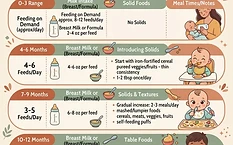
Baby Feeding Chart: Age-by-Age Guide from 4 to 12 Months (2026)
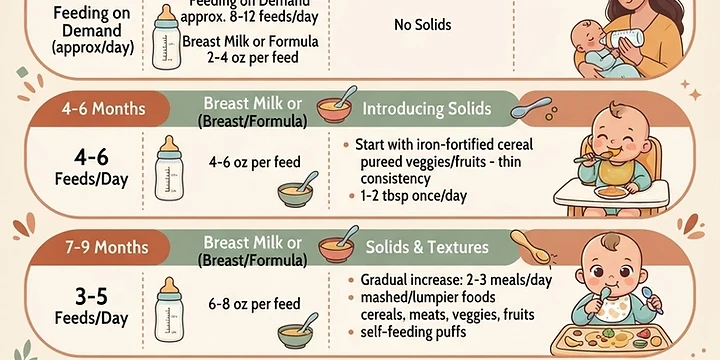
Free printable: the 6-month baby feeding chart
Grab the same chart we reference in this guide as a printable PDF — pin it to the fridge, no more guessing at portions.


In this article
Why You Need a Baby Feeding Chart
A baby feeding chart is one of the most useful tools a parent can have during the first year. A baby feeding chart provides clear, age-specific guidance on how much milk your baby needs, when to introduce solids, how much to feed, and what textures to offer at each month. Without a baby feeding chart, parents often feel uncertain about whether their baby is getting enough — a structured baby feeding chart eliminates guesswork. The baby feeding chart covers months 4 through 12, the period when feeding changes most dramatically. A baby feeding chart helps you track feeding progression, identify when to make changes, and spot potential issues early. Research shows that parents who use a baby feeding chart report higher confidence and lower feeding anxiety. The baby feeding chart is organized by month, with each month showing: milk volume, number of feedings, solid food portions (once solids begin), meal frequency, and texture stage. The baby feeding chart is a guideline, not a rigid rule — every baby is different, and the baby feeding chart should be adapted to your baby's individual needs, appetite, and growth. A baby feeding chart is especially useful for tracking changes over time and for communicating with your pediatrician about feeding progress.


Baby Feeding Chart: Month-by-Month Breakdown
Here is a baby feeding chart broken down by month. Month 4: baby feeding chart calls for 4 to 6 ounces of milk, 5 to 6 times per day (24 to 32 ounces total), no solids. Month 5: baby feeding chart shows 5 to 7 ounces, 4 to 5 times per day (28 to 32 ounces), no solids. Month 6: baby feeding chart introduces solids — 6 to 8 ounces of milk, 4 to 5 times per day (24 to 32 ounces) plus one solid meal (1 to 2 tablespoons). Month 7: baby feeding chart shows 6 to 8 ounces of milk, 3 to 4 times per day (24 to 30 ounces) plus two solid meals (2 to 3 tablespoons each). Month 8: baby feeding chart calls for 6 to 8 ounces of milk, 3 to 4 times per day (24 to 30 ounces) plus three solid meals (3 to 4 tablespoons each). Month 9: baby feeding chart shows 4 to 6 ounces of milk, 3 to 4 times per day (20 to 24 ounces) plus three meals and one snack. Month 10: baby feeding chart calls for 16 to 24 ounces of milk, plus three meals and two snacks (transitioning to table food). Month 11: baby feeding chart is similar to month 10, with increasing table food variety. Month 12: baby feeding chart transitions to whole milk (16 to 24 ounces) plus three meals and two snacks. This baby feeding chart provides a roadmap — always follow your baby's hunger cues and consult your pediatrician.
Ready to put this into practice?
Get our expert-crafted feeding guides and meal plans.


Using the Baby Feeding Chart Effectively
A baby feeding chart is most useful when you understand how to apply it to your baby's unique needs. The baby feeding chart provides averages and ranges — your baby may eat more or less than the baby feeding chart suggests, and that is normal. Use the baby feeding chart to ensure your baby is in the right range, not to force specific amounts. The baby feeding chart should be paired with responsive feeding — watch for hunger cues (rooting, sucking hands, lip smacking) and fullness cues (turning away, closing mouth, pushing food away). The baby feeding chart also tracks texture progression: months 4 to 5 (liquid only), month 6 (thin purees), months 7 to 8 (thicker purees and mashed with lumps), months 9 to 10 (chopped and finger foods), months 11 to 12 (table food). The baby feeding chart should be discussed at every pediatrician visit — bring your observations and ask if your baby's intake aligns with the baby feeding chart. If your baby consistently falls below the baby feeding chart ranges for milk or food intake, or if growth slows, consult your pediatrician. The baby feeding chart is also a helpful tool for caregivers, daycare providers, and partners — everyone involved in feeding should be on the same page. For a complete baby feeding chart with daily routines and printable templates, explore our Baby Feeding Schedule by Month Guide.
How to Use This Baby Feeding Chart Day to Day
The baby feeding chart works best when it's somewhere you'll actually see it — printed and stuck to the fridge, or saved as a photo on your phone for daycare drop-off. Start by circling your baby's current month, then use the baby feeding chart as a checklist rather than a strict quota: did they get roughly the right number of milk ounces, and if solids have started, roughly the right number of tablespoons or meals? Many parents pair the baby feeding chart with a simple notes app log — time, amount, and any reaction to a new food — for the first few weeks of each new stage, then taper off logging once the rhythm feels automatic. If you're still in the milk-only months, our 4 month old feeding schedule guide breaks down that specific stage in more detail, including sample daily timing. And if you're doing the math on ounces per feed, how much should a 4 month old eat answers that question directly with breastfed and formula-fed breakdowns. The baby feeding chart is a living document — expect to adjust it every few weeks as your baby's appetite, sleep, and solid food skills evolve.
Frequently Asked Questions
How much should my baby eat at each month?
The baby feeding chart shows milk volumes from 24 to 32 ounces (months 4 to 6), decreasing to 16 to 24 ounces (months 10 to 12), with solids starting at month 6 (1 to 2 tablespoons, increasing to full meals by month 8).
When does the baby feeding chart introduce solids?
The baby feeding chart introduces solids at 6 months, starting with one meal of 1 to 2 tablespoons per day, progressing to three meals by month 8 and three meals plus snacks by months 10 to 12.
Is the baby feeding chart the same for breastfed and formula-fed babies?
The baby feeding chart provides separate guidance for breastfed and formula-fed babies. Breastfed babies may feed more frequently (8 to 12 times in early months), while formula-fed babies have more predictable volumes.
How often should I update the baby feeding chart?
Revisit the baby feeding chart every 2 to 4 weeks, or sooner if you notice a growth spurt, a new tooth, or a sudden change in appetite. Most babies shift feeding patterns at least once a month during the first year.
Conclusion
A baby feeding chart gives you clarity and confidence throughout the first year of feeding. By tracking milk volumes, solid portions, and texture progression month by month, you ensure your baby thrives at every stage. For the 4-month milk-only stage specifically, see our 4 month old feeding schedule, and for a complete chart with daily routines and printable templates, explore our Baby Feeding Schedule by Month guide.
Ready to put this into practice?
Get our expert-crafted feeding guides and meal plans.


Dr. Emily Carter, MD
MD, Pediatrician
Pediatrician focused on infant growth and feeding schedules, helping parents translate AAP and WHO guidance into practical day-to-day routines.
Explore our feeding guides