Newborn Feeding Chart by Week
A week-by-week newborn feeding chart from birth to 3 months — milk amounts, feeding frequency, and growth expectations for every week of the newborn period.
Why Track Feeding Week by Week
The first 12 weeks bring rapid changes in feeding patterns — a newborn's stomach grows from about the size of a cherry at birth to the size of an egg by 3 months, and milk needs increase accordingly. Without a clear reference, it's easy to worry whether your baby is getting enough, especially in the early weeks when feeding is frequent and unpredictable. A week-by-week chart gives clear guidance on how much milk to expect at each stage, typical feeding frequency, and what growth patterns look like. Parents who track feeding this way tend to catch issues early — insufficient intake, a poor latch, reflux — before they affect growth, and it's especially useful for breastfeeding mothers working to establish supply. The newborn period breaks into three phases: weeks 1-4 (frequent feeding, establishing supply), weeks 5-8 (increasing volume, longer intervals), and weeks 9-12 (predictable patterns, night feeds easing). Each phase has its own volume targets, frequency, and growth expectations.
Weeks 1 to 4
This is the most intensive feeding period. Week 1: 1.5-2 ounces per feeding, 8-12 times a day (every 2-3 hours, including overnight) — a breastfed newborn may feed 10-12 times a day since breastmilk digests quickly, and by the end of the week intake typically rises to 2-3 ounces per feeding. Week 2: 2-3 ounces per feeding, 8-10 times a day, with your baby possibly starting one slightly longer stretch of sleep (3-4 hours) at night. Week 3: 3-4 ounces per feeding, 7-9 times a day — a common time for a growth spurt, when your baby may seem hungrier and feed more often for 2-3 days. Week 4: 3-4 ounces per feeding, 7-8 times a day, totaling 24-32 ounces. During this month it's normal to lose up to 10% of birth weight in the first few days, then regain it by week 2. Watch for at least 6 wet diapers and 3-4 dirty diapers a day as signs of adequate intake, and feed on demand throughout — never restrict feeds, since frequent feeding is what establishes milk supply for breastfeeding mothers. Evening [cluster feeding](/blog/cluster-feeding-newborn) — several feeds bunched close together — is especially common during weeks 1 to 4 and is a normal part of establishing supply, not a sign anything is wrong.
Weeks 5 to 8
This phase brings more predictable feeding and increasing volumes. Week 5: 4 ounces per feeding, 6-8 times a day (24-32 oz total) — another growth spurt often hits around week 6, bringing more frequent feeding for a few days. Week 6: 4-5 ounces per feeding, 6-7 times a day; by now most babies have regained their birth weight plus gained another 1.5-2 pounds. Week 7: 4-5 ounces per feeding, 6 times a day, and your baby may start sleeping one longer nighttime stretch (4-6 hours). Week 8: 4-6 ounces per feeding, 5-6 times a day (28-32 oz total). During this window feeding becomes more established and intervals more predictable, with growth averaging 0.5-1 ounce a day. Breastfed babies often become more efficient too, with nursing sessions shortening from 30-40 minutes down to 15-20 as skill improves. Keep watching hunger cues — rooting, sucking hands, lip-smacking — rather than the clock, using volume targets as a guide to total daily intake.
Weeks 9 to 12
As your baby approaches 3 months, feeding becomes more structured. Week 9: 5-6 ounces per feeding, 5-6 times a day (30-32 oz total). Week 10: 5-6 ounces per feeding, 5 times a day, and many babies start consolidating night sleep into one longer stretch of 5-7 hours. Week 11: 5-6 ounces per feeding, 5 times a day, often finishing feeds in 15-20 minutes as efficiency improves. Week 12: 5-6 ounces per feeding, 5 times a day (25-30 oz total). By 3 months most babies have doubled their birth weight and settled into a predictable routine with longer daytime intervals and fewer night feeds. During this stretch, keep an eye on the growth curve — steady weight gain along a percentile line is the clearest sign of adequate intake. It's also normal for breastfed babies to have a brief nursing strike or more distractibility during feeds around this age. As your baby heads toward 4 months, this week-by-week view gives way to the broader month-by-month schedule that eventually includes solid foods at 6 months — see our [6 month old feeding schedule](/category/6-month-old-feeding-schedule) for the full transition guide. For a complete chart with daily logs and growth trackers, see our Newborn Feeding Chart by Week Guide below.
Newborn Growth Spurts by Week: Signs, Timing & What to Feed
Why feeding suddenly spikes around weeks 3, 6, and 9 — the signs, how long each spurt lasts, and how to respond without doubting your supply.
Medically reviewed by Dr. Sarah Chen, MD · See our editorial policy
Featured Guides

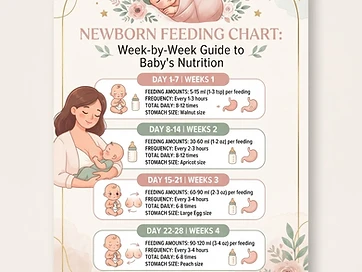 Lactation consultant-approvedNewborn Feeding Chart by Week
Newborn Feeding Chart by Week Guide
A complete newborn feeding chart by week from birth to 3 months — milk amounts, feeding frequency, growth milestones, and daily tracking logs for every week.
eBook (PDF)

 FreeNewborn Feeding Chart by Week
Free Newborn Feeding & Diaper Log (Printable Checklist)
Track feeds, diapers, and sleep through the newborn haze — a printable checklist that takes the mental math out of the first few weeks. Free.
Free printable (PDF)
Frequently Asked Questions
How much should a newborn eat per feeding?
Week 1: 1.5-2 oz. Weeks 2-4: 2-4 oz. Weeks 5-8: 4-5 oz. Weeks 9-12: 5-6 oz per feeding, with frequency decreasing from 8-12 to 5-6 feedings per day.
How often should I feed my newborn?
Aim for 8 to 12 feedings per day in the first 4 weeks (every 2 to 3 hours), decreasing to 5 to 6 feedings per day by weeks 9 to 12. Always feed on demand.
How do I know my newborn is getting enough?
Track diaper counts (6+ wet, 3-4 dirty per day), steady weight gain (0.5-1 oz/day), and contentment after feeds. Consult your pediatrician if concerned.