15 Safe Finger Foods for Baby (2026 Guide)
In this article
When to Introduce Finger Foods for Baby
Finger foods for baby are typically introduced around 6 months, when your baby can sit with support, hold their head steady, and bring objects to their mouth. Finger foods for baby are not just for baby-led weaning families — even if you started with purees, introducing finger foods for baby around 7 to 8 months helps develop the pincer grasp (thumb and finger pick-up) and chewing skills. The transition to finger foods for baby should be gradual: start with very soft foods that squish between your fingers, cut into stick shapes (the size of your index finger) for easy grasping. As your baby's skills develop, finger foods for baby can become smaller (pea-sized for pincer grasp practice) and firmer. Finger foods for baby should always be supervised — never leave your baby alone while eating. The benefits of finger foods for baby go beyond nutrition: they build fine motor skills, hand-eye coordination, independence, and a positive relationship with food. Whether you do BLW from the start or transition from purees, finger foods for baby are an essential developmental step.
15 Safe Finger Foods for Baby by Age
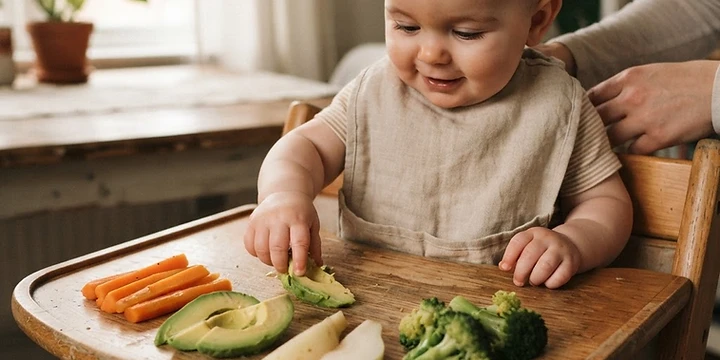
Here are fifteen finger foods for baby organized by age and texture. 6 to 8 months (soft sticks): 1. steamed sweet potato spears. 2. ripe avocado slices. 3. steamed carrot sticks. 4. soft pear spears. 5. banana halves (lengthwise). 6. steamed broccoli florets. 7. toast fingers with thin nut butter. 8 to 10 months (smaller pieces, pincer grasp): 8. small pasta spirals. 9. soft cheese cubes. 10. blueberries (smashed). 11. steamed green beans (cut in half). 12. scrambled egg pieces. 10 to 12 months (firmer textures): 13. soft chicken pieces. 14. mild cheese strips. 15. steamed apple slices (soft). These finger foods for baby progress in texture and size as your baby develops. Always cut round foods (grapes, cherry tomatoes, blueberries) lengthwise into quarters to prevent choking. Avoid whole nuts, popcorn, hard raw vegetables, and sticky foods like thick nut butter. Each finger food for baby should be soft enough to squish between your thumb and finger. Rotate through these finger foods for baby to expose diverse flavors and textures.
Ready to put this into practice?
Get our expert-crafted feeding guides and meal plans.
Safety Rules for Finger Foods for Baby
Safety is the top priority when serving finger foods for baby. First, always supervise — never leave your baby alone with finger foods for baby, even for a moment. Second, ensure proper posture — your baby should be sitting upright in a high chair, not reclined or lying down. Third, cut foods to safe shapes — round foods (grapes, cherry tomatoes, sausages) must be cut lengthwise into quarters, as round shapes can block the airway. Fourth, test the texture — if you cannot squish a finger food for baby between your thumb and finger, it is too hard. Fifth, avoid high-risk foods: whole nuts, popcorn, hard candies, raw hard vegetables (carrot, apple), sticky foods (thick peanut butter, marshmallows), and foods with pits or bones. Sixth, learn infant CPR and the difference between gagging (loud, coughing, normal) and choking (silent, blue, emergency). Seventh, serve age-appropriate portions — small amounts prevent over-stuffing. Eighth, let your baby control the pace — never put food in their mouth for them with finger foods for baby; this is how choking happens. Ninth, be mindful of allergies — introduce one new finger food for baby at a time and watch for reactions. With these safety rules, finger foods for baby become a joyful, developmental experience.
Frequently Asked Questions
When can I introduce finger foods for baby?
Finger foods are typically introduced around 6 months, or 7 to 8 months if you started with purees. Look for sitting with support and developing pincer grasp.
What are safe finger foods for baby?
Steamed sweet potato spears, avocado slices, soft pear, banana halves, and toast fingers are safe starters. Always cut round foods lengthwise and test that foods squish between your fingers.
How do I prevent choking with finger foods?
Always supervise meals, ensure proper posture in a high chair, cut round foods lengthwise into quarters, test texture, and learn infant CPR.
Conclusion
Finger foods for baby are essential for developing fine motor skills, independence, and a positive relationship with food. By following safety rules and progressing textures, you make self-feeding a joyful experience. For more finger food ideas and recipes, explore our feeding guides.
Ready to put this into practice?
Get our expert-crafted feeding guides and meal plans.


Elena Rodriguez, RD
RD
Registered Dietitian focused on first foods and baby-led weaning, with a practical, safety-first approach to introducing solids.
Explore our feeding guidesMedically reviewed by Dr. Sarah Chen, MD · See our editorial policy

